Showing posts with label Williams' Anti-Pain. Show all posts

2.11.2013

The Standard Medical Company Continued...

A few days ago I wrote a short piece on the Standard Medical Company of Lansford, Pennsylvania, which became quite popular due to their Williams’ Anti-Pain (‘Anti-Pahn’ was used as their patent name, because I’ve come to learn that they weren’t allowed to patent the word ‘pain’; ‘Auntie Payne’ was used in advertisements) salve, which helped to remedy almost any bruise or ache.

After I published the post, I was given a copy of the October 2003 edition of The Valley Gazette. While there are other Valley Gazettes, the one to which I’m referring was a small mom-and-pop publication from the Panther Valley area of Pennsylvania. The newspaper was run by the late Ed Gildea and focused on long-forgotten coal region news, lore, and the daily goings-on of life in the nearby coal towns. The circulation was so small that they literally knew their subscribers and, as my mom put it, they didn’t even have to ask for subscription renewals because they already knew that you would want one.


In the October 2003 edition of The Valley Gazette was a story about the Standard Medical Company and how Williams’ Anti-Pahn ointment came to be. I’m hoping that I don’t get into any problems for republishing the articles from this issue, but I doubt that I will. One thing that I’ve learned from growing up in the coal region of Pennsylvania is that a big facet of life is that of passing along stories about which you don’t want people to forget.

The first part is a description of how the ointment was made.
The Anti-Pahn workers started at 7 AM, first getting the petrolatum out of a 55-gallon drum into a big heavy metal pot and started heating Vaseline. Next, the menthol and camphor crystals were put in a pre-marked container with the methyl saliclate to dissolve.

About 8:30 AM was coffee break across the street to Mrs. Vadyak’s home with fresh rolls delivered by Kovaliskies bakery truck of Summit Hill. Mailman Roy Heffelfinger brought orders (mail was delivered twice a day in the early forties).

Back to work cleaning every jar to be filled with ointment that day. About 11 AM, pour the hot Vaseline with the other ingredients in a special unit with two small faucets on the bottom. Start filling jars while hot in liquid form. In the afternoon, after the jars cooled, they were capped and sent to the labeler for the black and green labels…then on the conveyor belt to be boxed, packaged and shipped. The filled cartons slid down a wide board from the upper level to the first floor.

The menthol crystals came from China and in 1942 were stored in a bank vault in Lansford until the new synthetics were available. Menthol cigarettes were made by putting an open pack in the menthol can.

[Employee Joe] Vadyak welcomed the job at the Standard Medical Company because he was just fired from Bright’s Department Store by Dick Edwards, store manager, because Joe wanted a pay raise from $13.70 a week that included 9 AM to 9 PM hours during the holiday season. Edwards told him he could get someone to do the job for $11 a week. Joe told him to get him and the next day he was let go from working with Jack Lannon in the display and advertising department. Lannon taught Joe the art of sign painting at the age of 17.

After Vadyak completed art school study in New York City, he was associated with advertising agencies and while doing freelance for American Lithocraft, he designed with Paul Kershner a new advertising piece with new artwork for Anti-Pahn. Paul ordered one hundred thousand to be printed.

While Vadyak was planning to study in New York, he took Harry Canter of New York, who was married to Mary Sverchek, into the Anti-Pahn operation. Canter changed the process, eliminating glass jar labeling and packaging. His wife Mary and her sister Ann continued the manufacturing process for years on West Abbott Street, Lansford.

The following is part of a letter sent to Ed Gildea from the late Gretchen Kellow in reference to the ointment:
Dear Ed,

I’m sorry I’m so tardy in responding to your letter but I haven’t felt up-to-snuff lately and each task becomes an effort.

Enough of that! Anti Payne was compounded by Willie Davis, a brother of Nan McCready’s. Willie Davis owned and operated a drug store at the southeast corner of Ridge and Tunnel Streets. When I left Lansford in 1979, it was owned by Nesbitt Company.

Nan McCready was a school teacher in the Lansford High School for many years [and] had a daughter Jean McCready who married a heavy guy who drove the Lansford ambulance for a long time and was once a member of the Merchant Marines. Unfortunately, I’ve forgotten his name.

After Willie Davis, a pharmacist, concocted the Anti Payne formula in the cellar of his drug store, a group of Lansford businessmen bought stock in the company. It never went public but continued to be owned by a group of Lansford businessmen, namely Paul Kershner, who married Dora Davis (a sister of Willie Davis) and Ben Arthur, a Lansford lumberman and leading leader of many civic groups in Lansford, my father, Stan Druckenmiller, the physician, and I believe Charlie Walton (my maternal grandmother’s brother), who lived in the house at the corner of Tunnel and Bertsch, where when I left Lansford in 1979, Emil Demyanovich lived. Many people tried to go public with Anti Payne and introduce it on TV, newspapers, etc., but the controlling interests in the stock ownership would never sell it. George M.D. Richards was a heavy stockholder in the company. Eventually Lib and Bob Lewis began to be the “agents” for Anti Payne when I believe a man named Canter used to make it and dispense it out of a warehouse on West Water Street. Lib Lewis was the secretary more or less and took care of the business end of the business. Lib is still living at 28 W. Bertsch St. in Lansford, as far as I know.

I have taken the liberty of writing to her and asking her to call you and tell you what she knows about Anti Payne. I don’t know whether she has done this or not yet. Our family loved Anti Payne and so did everyone who ever used the product. It burns your skin so badly that it drove away the pain that was hurting you. But it was really great stuff. Many Lansfordians sent for her by mail after they no longer lived where they could get it in Lansford. I hope this is of some help in your coming article on this product but call Lib Lewis and ask her if she can fill you in on any of the details of the company.

To my knowledge, The Valley Gazette is now gone with the passing of Mr. Gildea a few years ago, but I figured it would be a shame to not pass along these two tidbits for those who might be researching either the Standard Medical Company or Williams’ Anti-Pahn ointment.

1.21.2013

Whatever Happened to…?


...the Standard Medical Company of Lansford, Pennsylvania.

Now that I’ve moved into a new house, I’ve discovered old things packed away which I forgot that I had. Old hockey sweaters, baseball cards, writings, etc.—they were with me the entire time but I completely forgot about them.

Another few items that I came across were several boxes and bags of paperwork, stock certificates, and correspondence from the defunct Standard Medical Company of Lansford, Pennsylvania. The company made the popular Williams’ Anti-Pain ointment—or Anti-Pahn and Auntie Payne, as they also used in a few advertisements—which had a devout customer base not only across the country but also around the world, as evidenced by the correspondence.

The only reason that I’m even writing about this is because I discovered that some of the ointment’s users took to the Internet to ask about whether or not they could still purchase this amazing salve.

To put it briefly, the answer is no, you cannot purchase Williams’ Anti-Pain ointment anymore because the Standard Medical Company in Lansford, Pennsylvania, no longer exists and the formula was not purchased by anyone following the company’s closure.

Here’s the company’s story in a nutshell:

While it formed as a partnership in 1906 between William D. Davis and Charles E. McGinley, the Standard Medical Company incorporated in the 1920s—before the stock market crash of 1929—and was able to survive not only the Great Depression, but make a successful run all the way until around 1996 or 1997 (I forget the actual date when they dissolved as a corporation). Their claim-to-fame was an ointment called Williams’ Anti-Pain, which was akin to Icy Hot or Ben Gay but according to many of its users, Williams’ Anti-Pain was a thousand times better.

By the time that the mid-1990s rolled around, the owners and workers of the company were getting up in age and they were also faced with a dilemma of having to make major upgrades to their manufacturing processes. Stoves to produce the product, ventilation fans to clear the air of the building, ingredient holding areas, etc.: each of these aspects of production would have to be upgraded to meet new stringent FDA standards. From what I was told privately at the time—and at this point, I don’t mind saying it publicly—most of the new federal guidelines were put in place because larger corporations had paid (lobbied) both state and federal officials in order to shut down the smaller companies like Standard Medical in order to reduce competition.

A small business like Standard Medical couldn’t afford to upgrade to equipment that big corporations could purchase at the drop of a hat. They weighed their options and the only realistic one was to fold the business.

They attempted to sell the formula and name “Williams’ Anti-Pain” to anyone who might be interested. Since my late father was their accountant at the time, I personally was put in charge of collecting each and every known customer name as well as their address to notify them if a new buyer was found. By the end of the job, I had amassed a 20-page list of names of people from all over the world. If you’re reading this right now and ever sent a letter to the Standard Medical Company, you probably received a reply from me at some point. I actually responded to all 400 names or so on the list.

As the company was folding, there was only one serious prospective buyer, but unfortunately he pulled out of the deal at the last minute after he realized just how much money would have to be sunk into the endeavor in order to allow him to compete with the larger salve corporations. The product and the name were shopped around a little while longer with no positive results.

So to answer the question of if the Standard Medical Company of Lansford, Pennsylvania, is still in business or if you can purchase Williams’ Anti-Pain ointment any longer, the answer is no. Sadly this will be part of Americana from the 1920s to the mid-1990s and that’s where the story ends.

If you still have your old jars of Anti-Pain ointment, hold on to them for posterity. They’re not only evidence of a quality product but also evidence that at one time small businesses were allowed to exist in the United States and didn’t have to fear being shut down by their own government.

UPDATE: December, 2015
I’m not on Facebook, so I had no idea that Williams’ Anti-Pain Ointment was being discussed among folks from Pennsylvania on a coal region group page.

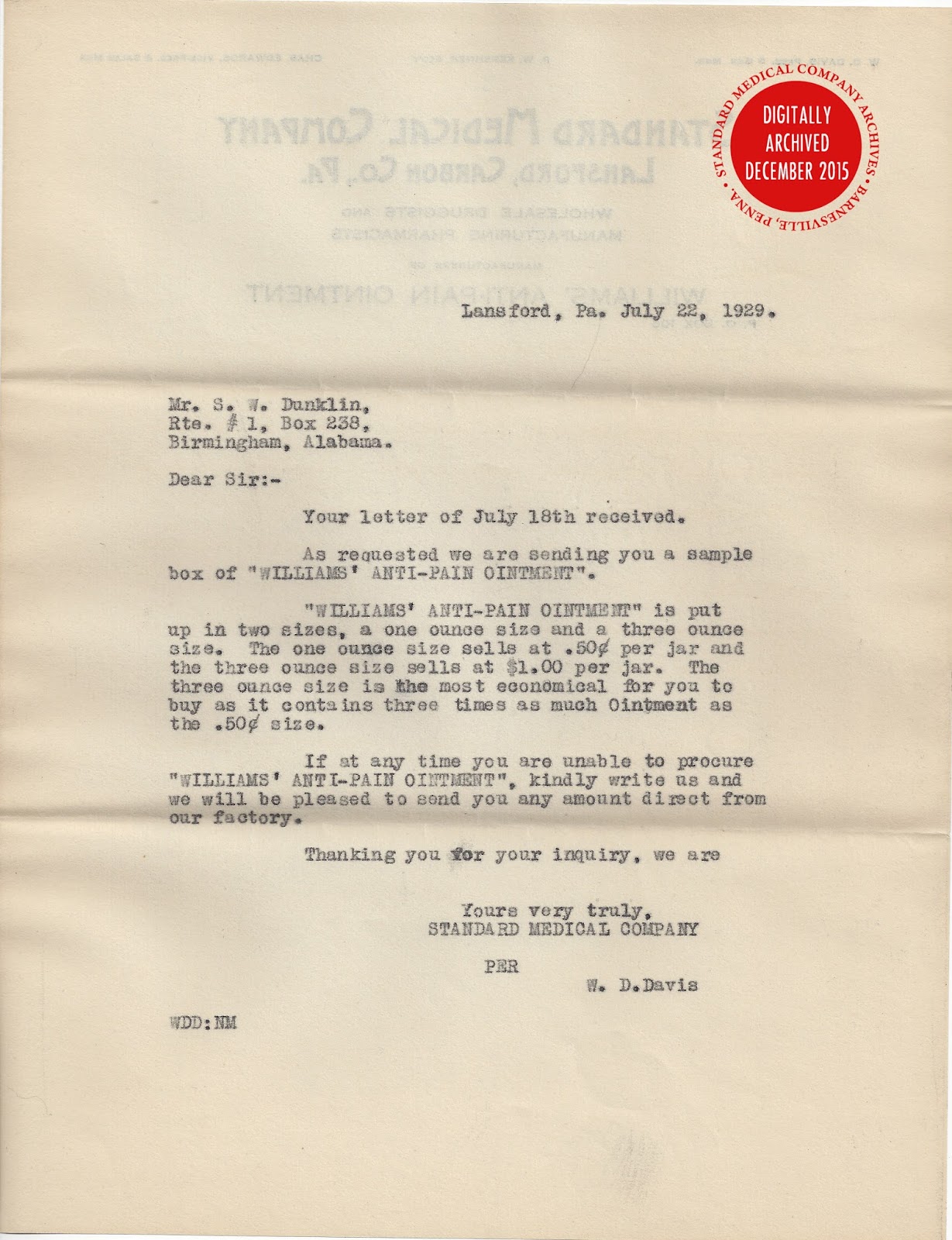
Anyway, given that that is the case, I’ve decided to upload some of the old documents and other items from the former Standard Medical Company that I’ve had in my possession since the company’s dissolution in the mid-1990s.

On June 3, 1922, William D. Davis, Paul William Kershner, and Charles Edwards are made election officers to conduct the election for directors of the Standard Medical Company.

While I don’t seem to have the “letter of a few days ago” from the J.B. Williams Company, it appears that in 1928 the Standard Medical Company was being questioned on their use of the name “Williams” by the J.B. Williams Company, which at the time produced shaving cream, talcum powder, and toilet soaps. Company president William D. Davis explained his position to the Glastonbury company. Note that the company was formed by Davis and Charles E. McGinley of Mauch Chunk but would later move to Lansford after Davis bought McGinley's interest in the company.

This application for registration of insecticides and fungicides offers a prototype label for a product called Pestmist (or Pest Mist). Not much documentation for Pest Mist came after this February 6, 1929, document, so I’m assuming that this product was either short-lived or simply didn’t get off the ground.

In 1950, the Standard Medical Company hired the A.H. Wirz Company to make prototype collapsible tubes for their Williams’ Anti-Pahn Ointment (the explanation for the use of “pahn” instead of “pain” follows in the documents below). I’m not sure if these were ever formally adopted for use, and if they were, how much they were used.


Standard Medical Company common stock.


One hundred shares of Standard Medical Company stock, obtained by president William D. Davis. This is a photo as opposed to a scan because the certificate is affixed to the stock book and I have no intention of removing it.
A mortgage from The Progressive Building and Loan Association of East Mauch Chunk. The first was filed in 1914 and the second in 1915. Prior to their building near the corner of West Abbott and Sharpe Streets, it is my understanding that the Standard Medical Company had properties along East Ridge Street near both Chestnut and Tunnel Streets, with the Tunnel Street property being a drug store owned by William D. Davis. Their West Abbott Street building was built at some point after the mid-1960s but I'm not sure on the exact date. There also were references to a West Water Street warehouse that was used when Harry Canter came into the picture with the company.

Back of the mortgage.

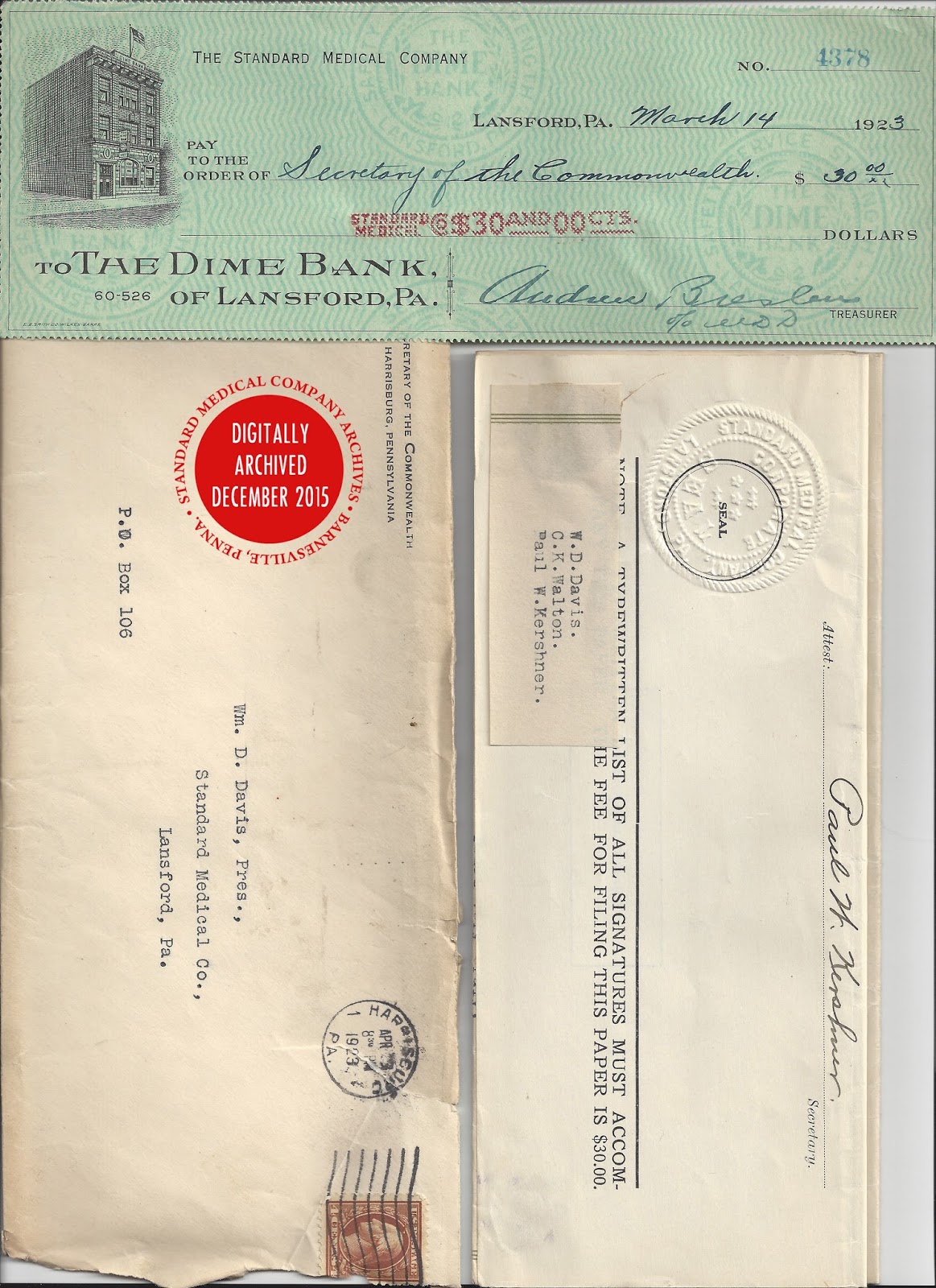
This check for $30 was made payable to the Secretary of the Commonwealth of Pennsylvania as a filing fee for board elections in 1923. A note attached explains that the check was no longer needed after it was made. The account was at the old Dime Bank of Lansford, located at 7 West Ridge Street.
The Lansford Dime Bank during the Standard Medical Company era, probably from sometime between the 1930s and 1950s. As noted, this photo is from the book Lansford: The First One Hundred Years by Richard J. Hoben. From what I've been told, the book was a one-time publication for Lansford's centennial celebration in 1976 and is only available in used form online. I'm publishing this photo for informational purposes only and no infringement is intended. If you're into local history, the book is worth purchasing.

In 1924 and into 1925, the Standard Medical Company had been selling insecticide to kill flies made by the Hance Brothers and White Company in Philadelphia. Known as Fli-Kil (also spelled "Fly-Kil" on some documents), the Standard Medical Company discovered that Hance Brothers and White, who were a well-known chemical and pharmaceutical company at the time, had sold them insecticide that didn't actually include the active fly-killing ingredient pyrethrum flower. The Standard Medical Company threatened legal action against Hance Brothers and White if they did not rectify the situation. Additional documents go on to show that Hance Brothers and White agreed to add 5% pyrethrum flower to all existing bottles of the bogus insecticide to avoid any litigation.

Below are numerous documents that were in the collection following the company’s closure. The first document is an apology letter from a customer who could not pay for her salve. Keep in mind that it was written during the Great Depression. It serves as a reminder of what hardship really was and really is. Nowadays we complain if we get bad cell service; in the 1930s they went days without eating.

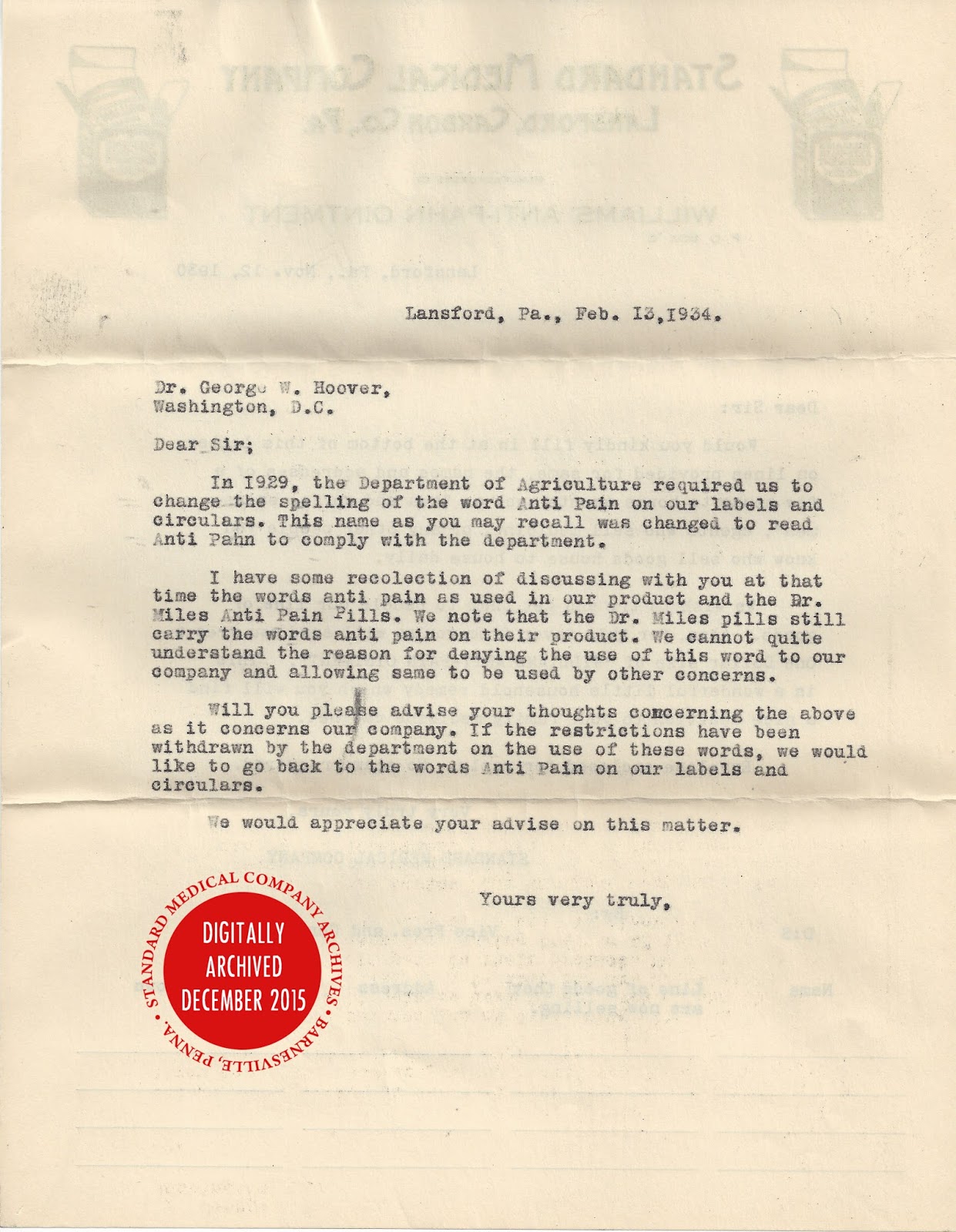
The other documents are correspondence regarding the patent and name “Anti-Pain.” From what I’ve come to understand from reading these, the Standard Medical Company was given a hard time by the federal government regarding both the attempt at patenting the word pain as well as the term “anti-pain” because it was determined that the salve would have to alleviate all known pain a human body could have to justify such a moniker.

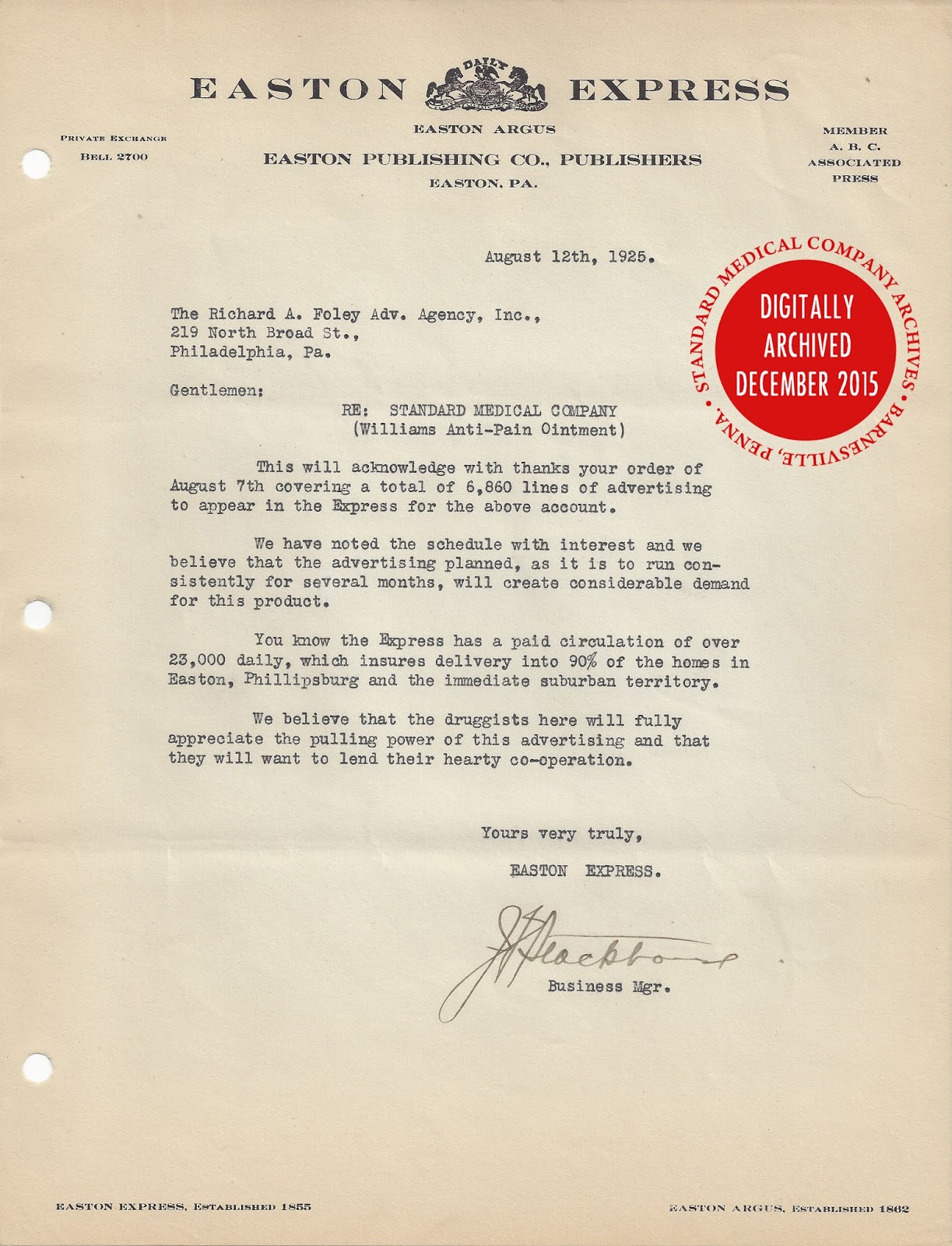
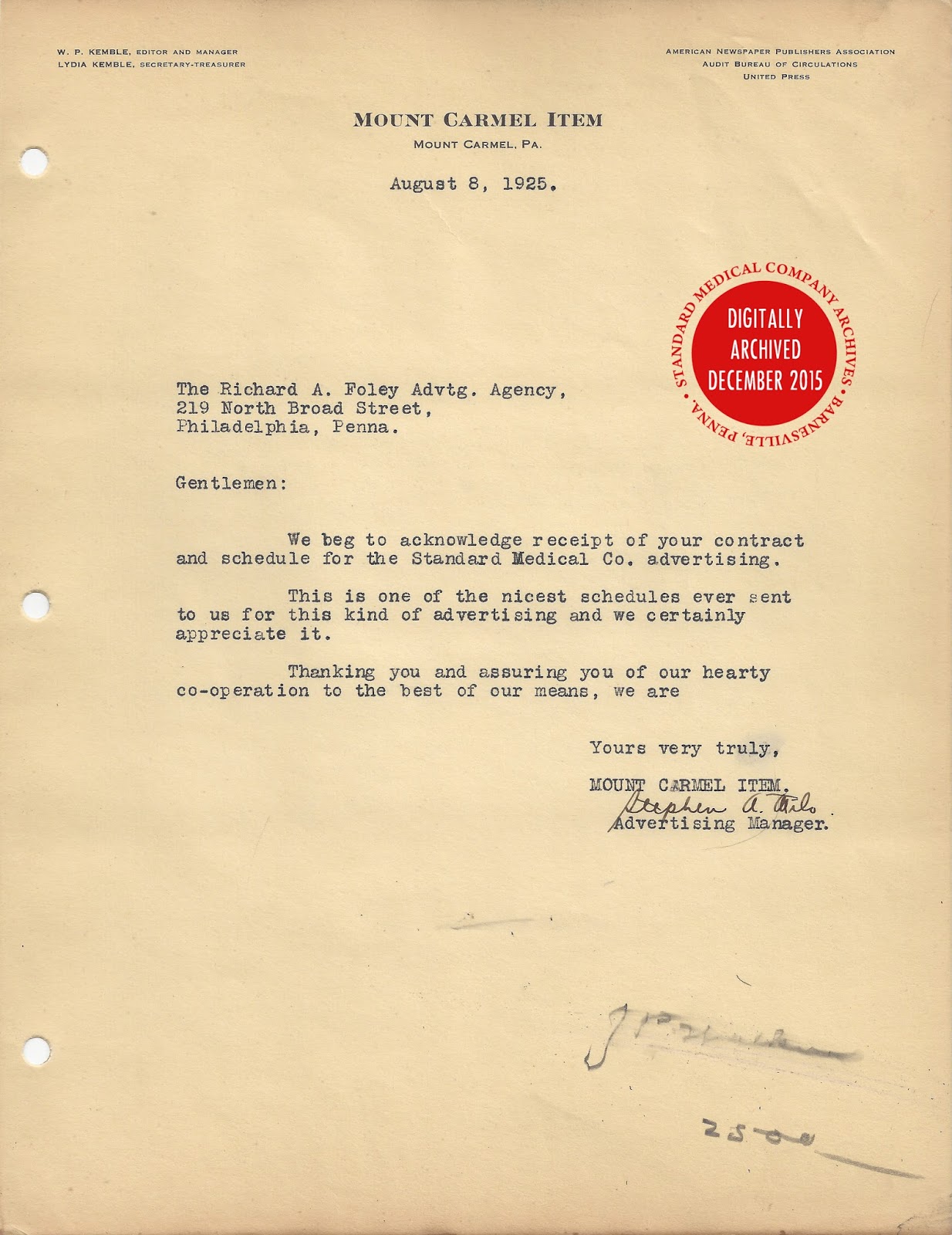
The last set of documents from this batch are letters from local newspapers that are thanking the Standard Medical Company and the Richard A. Foley Advertising Agency for their generous business. The advertisements follow those.

Please excuse the watermarks on each image. I did notice that other images had a habit of showing up on other Websites without information as to where the images originated. Please feel free to share any of these if you find them interesting or useful.

A letter of apology from Mrs. Mary Sams of Jeffersonville, Ohio. She was not able to pay her bill during the Great Depression.


Different possibilities for the spelling of the term "anti-pain." You will see in the proceeding correspondence that the phrase "anti-pain" became debated by the federal government, and in particular the Patent Office.


A form for salesmen in 1930.


The Williams' Anti-Pain Ointment newspaper advertisement from 1923.

The Williams' Anti-Pain Ointment newspaper advertisement from 1925.

The Williams' Anti-Pain Ointment newspaper advertisement from 1926.


The documents below are related to the Standard Medical Company’s relationship with stock promoter W.E.A. Wheeler of New York City during 1929. Wheeler was also the president of the Union National Life Insurance Company after stints with Standard Mutual Life of Pittsburg and the Quaker City Life Insurance Company of Philadelphia.

W.E.A. Wheeler's June 12, 1929, Western Union telegram informing W.D. Davis that he will arrive in Mauch Chunk by way of the Black Diamond steam locomotive.

The Black Diamond Express. (Image courtesy of the Library of Congress.)


A letter of recommendation for W.E.A. Wheeler from James S. McAnulty, president of the Scranton Life Insurance Company.

Front cover of a brochure entitled "The Wheeler Plan." 

Preliminary stock offering for the Aircraft Corporation of America.

A form for samples sent to Eureka Stores. Note that along with their Anti-Pain Ointment, the company also sold Williams' Candy Cathartic Wafers.